Category: Lab Updates
-
Poster Presented at the 2021 Eastern Psychological Association (virtual!) Annual Meeting
On Friday, March 6th, research assistants Kirsten Ostbirk and Itzel Herrera Garcia presented research (virtually) at the 2021 Eastern Psychological Association Annual Meeting. The poster described the results of a study conducted by the Bap Lab which investigated the impact of student-professor rapport on students active learning discomfort. The poster is available below.
-

Lab awarded funding from Bard Summer Research Institute (BSRI)
Research assistants Kirsten Ostbirk and Itzel Herrera Garcia will be conducting research in the Bap Lab this summer as a part of the Bard Summer Research Institute (BSRI) Program. Primary research topics for the summer include the implementation of eye tracking technology as well designing and conducting surveys on the relationship between social anxiety and…
-
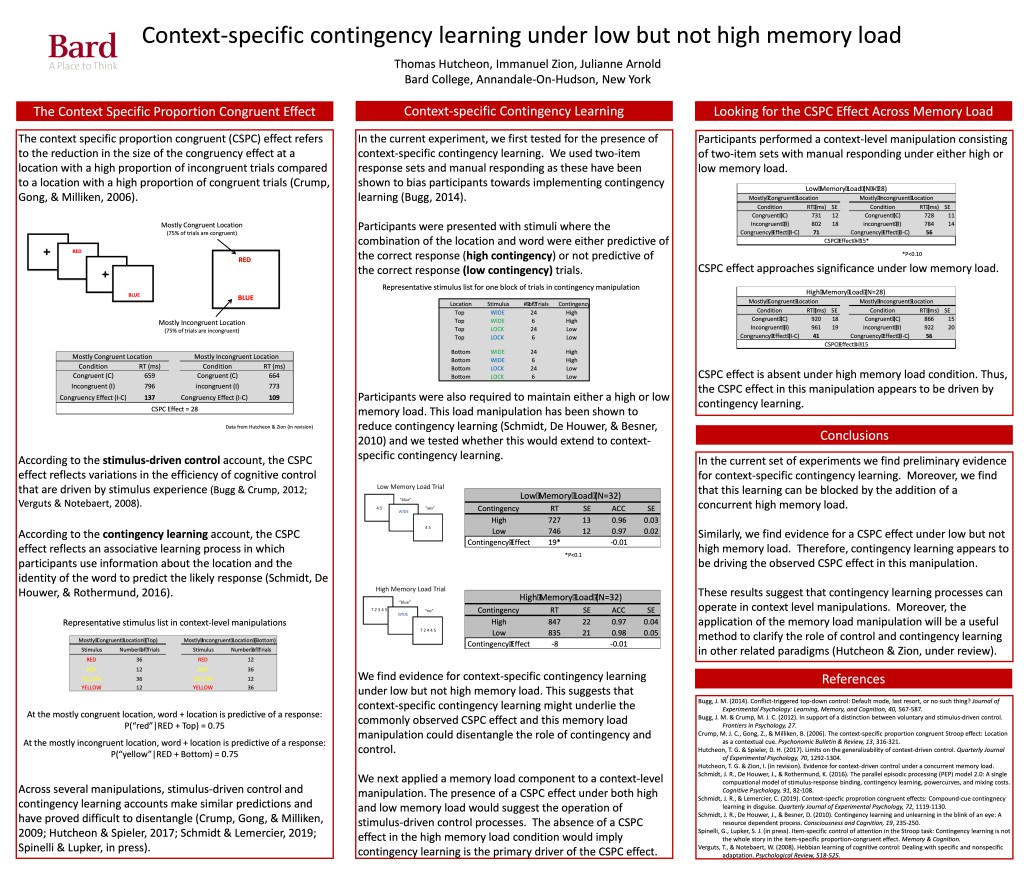
Poster Presented at Psychonomics 2019
On Friday, November 4th, Prof. Hutcheon presented research at the annual meeting of the Psychonomic Society in Montreal, Quebec, Canada.The poster described the results of a study conducted by the BAP Lab which investigated whether a secondary memory task would impact the presence of contingency learning in the Stroop task. The poster is available here:…
-
Poster Presented at Eastern Psychological Association Annual Meeting
On Friday, March 4th, Prof. Hutcheon and research assistant Immanuel Zion presented research at the Eastern Psychological Association Annual Meeting in New York, NY. The poster described the results of a study conducted by the cognitive ctrl lab which investigated whether a secondary memory task would impact the presence of stimulus-driven control. The poster is…
-
New Publication in Teaching of Psychology
Research conducted in the cognitive ctrl lab has recently been published in Teaching of Psychology. In this paper, we find a reduction in student engagement in sections of introduction to psychology where a technology-ban was implemented compared to sections where students are free to use technology. You can access the paper here.
-
Snowed in from Psychonomics
On Thursday, November 15th, the Cognitive Ctrl lab was set to head to New Orleans to present recent work at the Annual Meeting of the Psychonomic Society. Unfortunately, an early season snow storm dumped over 6 inches of snow on New York (the second most snow in November since the 1800s) leading to a cancelled…
-
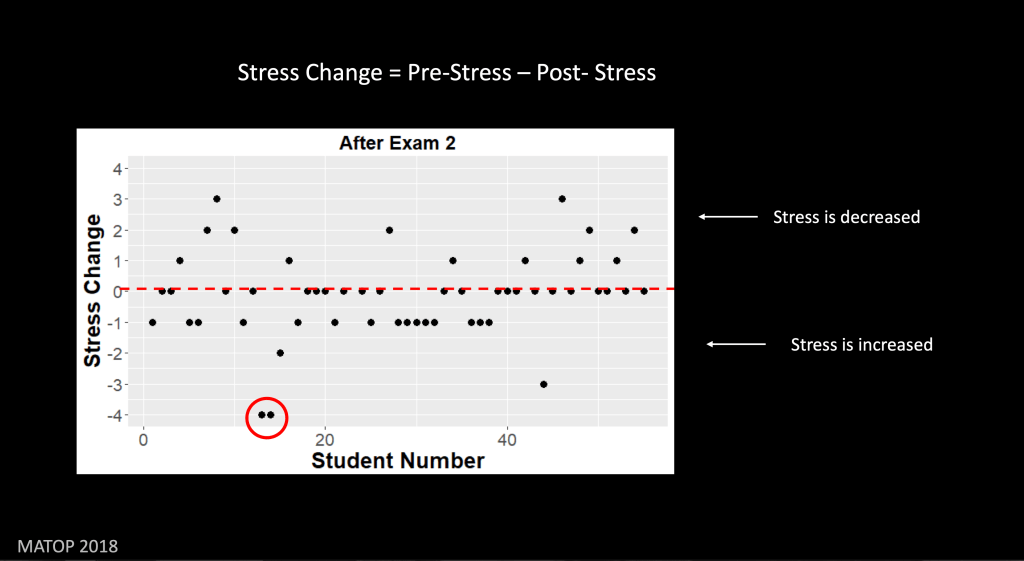
Research Presented at Annual MATOP Conference
On Friday, September 28th, Prof. Hutcheon presented research at the Annual Mid-Atlantic Teachers of Psychology (MATOP) Conference in Largo, MD. This talk described the results of a study conducted by the cognitive ctrl lab which investigated how providing students with detailed visualizations of their grade over the course of the semesters impacted student stress and…
-
Research Assistants Recognized for Academic Excellence at Commencement
Graduating research assistants Aileen Lian and Elizabeth Fitzgerald both received academic prizes at the 2018 Bard College Commencement exercises. Aileen earned the Andrew Jay Bernstein Prize given to a senior in recognition of the originality and quality of the Senior Project in Psychology. Elizabeth earned the Dr. Richard M. Siegel Memorial Prize in Science given…
-
Research Presented at Psychology Program Spring Colloquium
On Thursday, March 29th, Prof. Hutcheon presented work conducted in the lab regarding the generalizability of context-driven control. The results of these three studies suggest that under some (but not all) conditions, context-driven control can be accounted for by variations in the efficiency of control processes and not simply due to contingency learning.
-
Poster Presented at Annual NECTOP Conference
On Friday, October 20th, Prof. Hutcheon presented work done in collaboration with research assistants Sigi Nielsen, Elizabeth Fitzgerald, and Aileen Lian at the Northeast Conference for Teachers of Psychology (NECTOP) annual meeting in Newton, Mass. The poster described preliminary results showing the impact of grade visualization on students self-reported academic related stress.

