
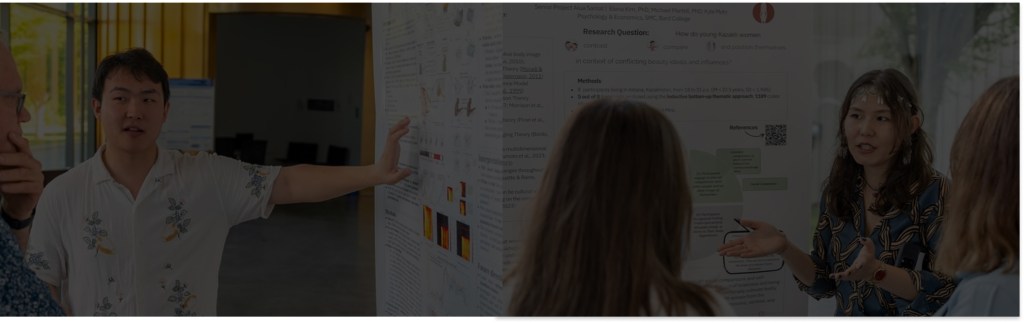
Senior Projects
Photo: Bard College (@bardcollege), Instagram, 2025
Senior Projects Supervised by Prof. Hutcheon (**indicates empirical project)
- Yserwrantz Lubin (Fall 2024 – Spring 2025). The Missing Link: Aging Out and The Role of Parental Support On College Persistence, Emotional Distress, and Social Isolation, Foster Care Alumni and First-Generation Peers**.
- Xuan Ma (Fall 2024). Stable Action Symbols in PMv Across Recording Sessions & Dynamic Switching of Vision, Planning, And Motor Neural Codes in the Macaque Brain**.
- Clara Retzloff (Fall 2024, Spring 2025). Processing Human and Monkey Faces: An Eye-Tracking Study**.
- Quinn Seger (Spring 2025). Communication as Connection: A Dialogic Approach to Engagement, Comprehension, and Trust in Psychology.
- Calum Tinker (Fall 2024 – Spring 2025). The Architectural and Environmental Psychology of Danish and American Prisons.
- Justyne Ingwu (Spring 2024). Effects of Animosity on Smoking Stigma: The moderating effects of race**.
- Luis Jhamil Rondon (Spring 2024). The Impact of Religiosity and Spirituality on Wellbeing: The Mediating Effect of Positive Emotions and Perceived control.
- Jared Toby (Spring 2023). The effectiveness of virtual training: Comparing virtual and in-person sport specific cognitive training**.
- Atom Carrasco (Fall 2022 – Spring 2023). The feeling of control: The psychology behind immersive controls in video games and their real-world effects.
- Asa Kaplan (Fall 2022 – Spring 2023). A repulsive inquiry: Evaluating the impact of cognitive load on aversive gaze behaviors following exposure to disgusting and fearful stimuli **.
- Henry McCulllers (Fall 2022 – Spring 2023). The Power of Wake and Sleep Incubation
in Creative Problem Solving. - Ana Quigley (Fall 2022). Analyzing the effects of video games on social anxiety and communication.
- Cam Goldberg (anticipated Spring 2022 – Fall 2022). Is transphobia conditional? The effects of coming out before or after an interaction**.
- Itzel Herrera Garcia (Spring 2022 – Fall 2022). The power of representation: Media representation of black people in relation to implicit bias**.
- Ivy Wu (Fall 2022). How lyrics influence the effect of music on emotions regarding differences in musical training**.
- Freddie Hernandez (Fall 2021 – Spring 2022). Color me impressed: Using the lexical decision task to understand color-word associations.**
- Jess Rylander (Fall 2021 – Spring 2022). The effects of music-induced emotion on memory**.
- Anya Swinchoski (Spring 2021 – Fall 2021). A Major Decision: Examining the relationship between emotional intelligence, acting with awareness, and college major satisfaction**.
- Isabella Cruz-Vespa (Fall 2020 – Spring 2021). The College Choice: Adolescent Identity Uncertainty and Group Entitativity**.
- Poppy Sheehan (Fall 2020 – Spring 2021). Back to Wonderland: Can imaginative play improve creativity in adults?
- Gabriela Rosado Torres (Fall 2020 – Spring 2021). Music as Medicine: Supporting NASA’s Advancement into Long-Duration Space Missions.
- Kirsten Ostbirk (Spring 2020 – Fall 2020). The differences in attentional gradients between synesthetes and non-synesthetes identified through visual search**.
- Alina Augustin (Fall 2019 – Spring 2020). The effects of virtual reality on motor performance in the first person point of view**.
- Immanuel Zion (Fall 2019 – Spring 2020). The effect of smartphone separation and dependence on selective attention**.
- Nikolai Grumet (Fall 2018 – Spring 2019). Reducing panic through olfaction.
- Rachael Rice (Fall 2018 – Spring 2019). How creating art impacts visual perception**.
- Elizabeth Fitzgerald (Spring 2018). Nothing tastes as good as starvation feels: Anorexia nervosa as a maladaptive mechanism of emotion regulation.
- Aileen Lian (Fall 2017 – Spring 2018). “Boys will be Boys”: Examining the relationship between men’s conformity to masculine norms and perceptions of psychological abuse.**[Winner of the 2018 Andrew Bernstein award for the best senior project in psychology at Bard College]
- Chanya Riddick (Fall 2017 – Spring 2018). The unwilling spectator: How secondary exposure to trauma through journalism effects emotional processing.** (link)
- Sydnie Sinclair (Fall 2017 – Spring 2018). Cream of the crop of the bottom of the barrel: An exploration of the variation in susceptibility to social influences present in genocides**.
- Eva Frishberg (Fall 2016 – Spring 2017). The impact of self-generated growth narrative on women’s persistence and effort on math tasks ** . [Winner of the 2017 Andrew Bernstein award for the best senior project in psychology at Bard College]
- Sarah Genung (Fall 2016 – Spring 2017). Human chameleons: Are biracial individuals with integrated racial identities more prone to body dissatisfaction?
- Glenisha Givens (Fall 2016 – Spring 2017). Putting micro-aggressions under the microscope: Examining the effects of micro-aggressions on student engagement in the college classroom**.
- Maayan Eldar (Fall 2015 – Spring 2016). What’s your type?: Readability of fonts across native and non- native English speakers**.
- Zachary Goodman (Spring 2016). Contrasting substance abuse and mobile gaming addiction.
- Nicole Lang (Fall 2015 – Spring 2016). The influence of arousal on the perception of colors**.
- Veronika Mojzesova (Spring 2014 – Fall 2015). The difference in motor memory as a function of the characteristic movements of musical instruments.
- Michelle Lee. (Fall 2014 – Spring 2015). Eating disorders in Asian-American women: Self-esteem and fat phobia**.
 Bard Attention and Performance Lab